> ## Documentation Index
> Fetch the complete documentation index at: https://docs.valkyrieapp.azumo.com/llms.txt
> Use this file to discover all available pages before exploring further.
# Aliases
> Give a deployment a stable, human-readable URL.
An **alias** is a stable, readable name for a deployment. Instead of hard-coding a
raw deployment slug in your application, you call a friendly path that you control:
```
https://valkyrie-back.azumo.com/{account_slug}/{alias}/v1/chat/completions
```
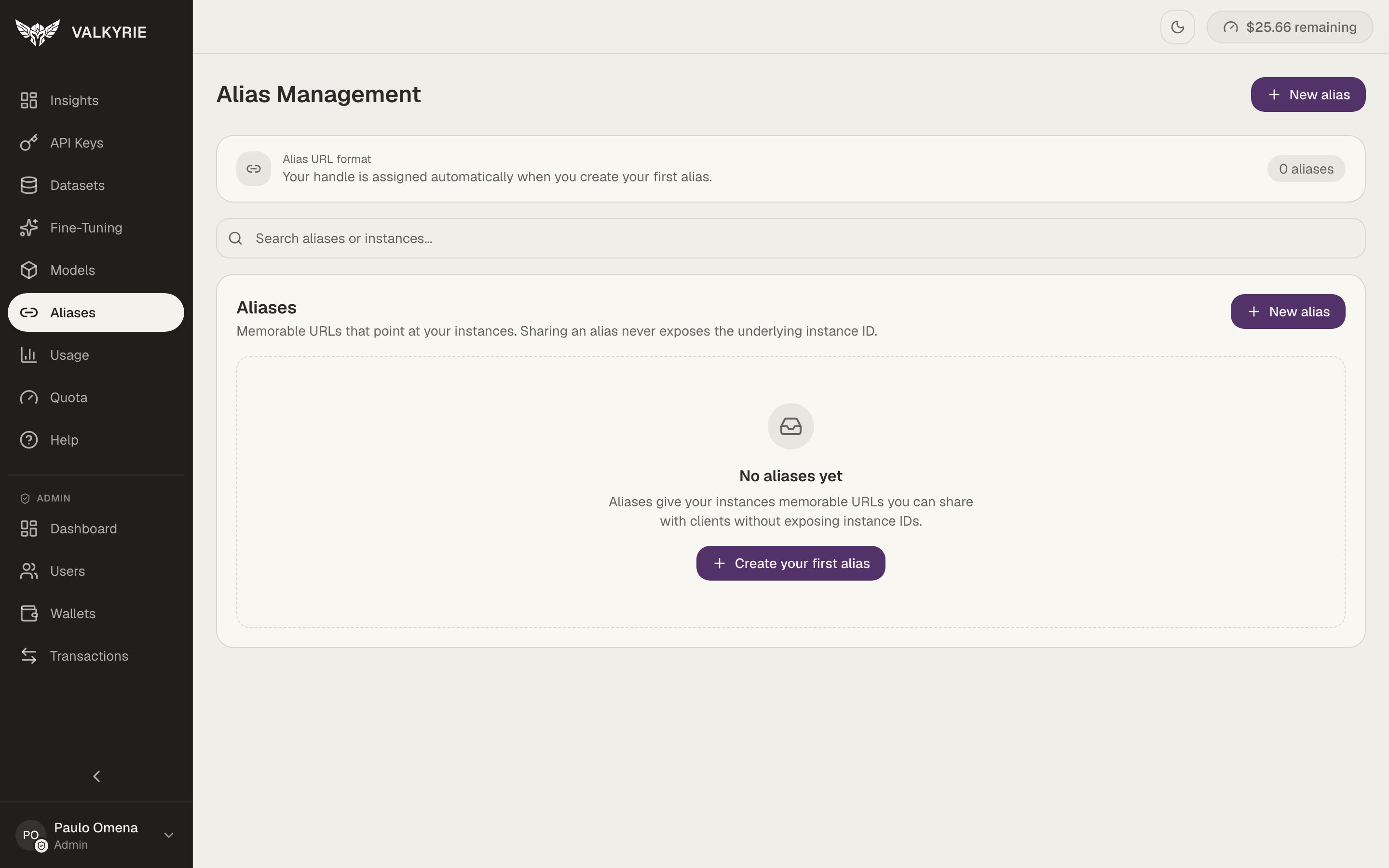 Your account **handle** (the `{account_slug}` part of the URL) is assigned
automatically when you create your first alias.
## Every deployment already has a URL
You don't have to create an alias. Every deployment is reachable at a **default,
non-guessable URL** (a random public id), so it's never addressed by a guessable
sequential number. An alias is an **optional, memorable name** you add on top when
you want something friendlier than the default id.
## Why add an alias
* **Memorable.** `acme/support-bot` is easier to share and reason about than the
default public id.
* **Stable and re-pointable.** Keep the same alias while you swap the deployment
behind it, so your applications never change their configuration.
## Create or manage aliases
You'll use this to add a **custom** alias (a name you choose) on top of a
deployment's default URL, or to manage an existing one. An alias is also offered as
an optional field when you deploy a model.
Go to **Aliases** in the dashboard, or use **Manage aliases** on a model's
detail screen to jump straight there with that deployment preselected.
Create an alias and map it to one of your ready deployments, or give a
deployment a custom name.
Use the alias path in place of the deployment slug in any OpenAI-compatible
client.
## Re-point an alias
An alias name is fixed once created, but you can **re-point** it at a different
deployment at any time (to rename, delete it and make a new one). Point production
traffic at an alias, then move the alias to a new deployment once you've verified it.
Clients never need to change their configuration.
Your account **handle** (the `{account_slug}` part of the URL) is assigned
automatically when you create your first alias.
## Every deployment already has a URL
You don't have to create an alias. Every deployment is reachable at a **default,
non-guessable URL** (a random public id), so it's never addressed by a guessable
sequential number. An alias is an **optional, memorable name** you add on top when
you want something friendlier than the default id.
## Why add an alias
* **Memorable.** `acme/support-bot` is easier to share and reason about than the
default public id.
* **Stable and re-pointable.** Keep the same alias while you swap the deployment
behind it, so your applications never change their configuration.
## Create or manage aliases
You'll use this to add a **custom** alias (a name you choose) on top of a
deployment's default URL, or to manage an existing one. An alias is also offered as
an optional field when you deploy a model.
Go to **Aliases** in the dashboard, or use **Manage aliases** on a model's
detail screen to jump straight there with that deployment preselected.
Create an alias and map it to one of your ready deployments, or give a
deployment a custom name.
Use the alias path in place of the deployment slug in any OpenAI-compatible
client.
## Re-point an alias
An alias name is fixed once created, but you can **re-point** it at a different
deployment at any time (to rename, delete it and make a new one). Point production
traffic at an alias, then move the alias to a new deployment once you've verified it.
Clients never need to change their configuration.